A Baby Was Born With a Ventricular Septal Defect (Vsd). Course Hero
Overview
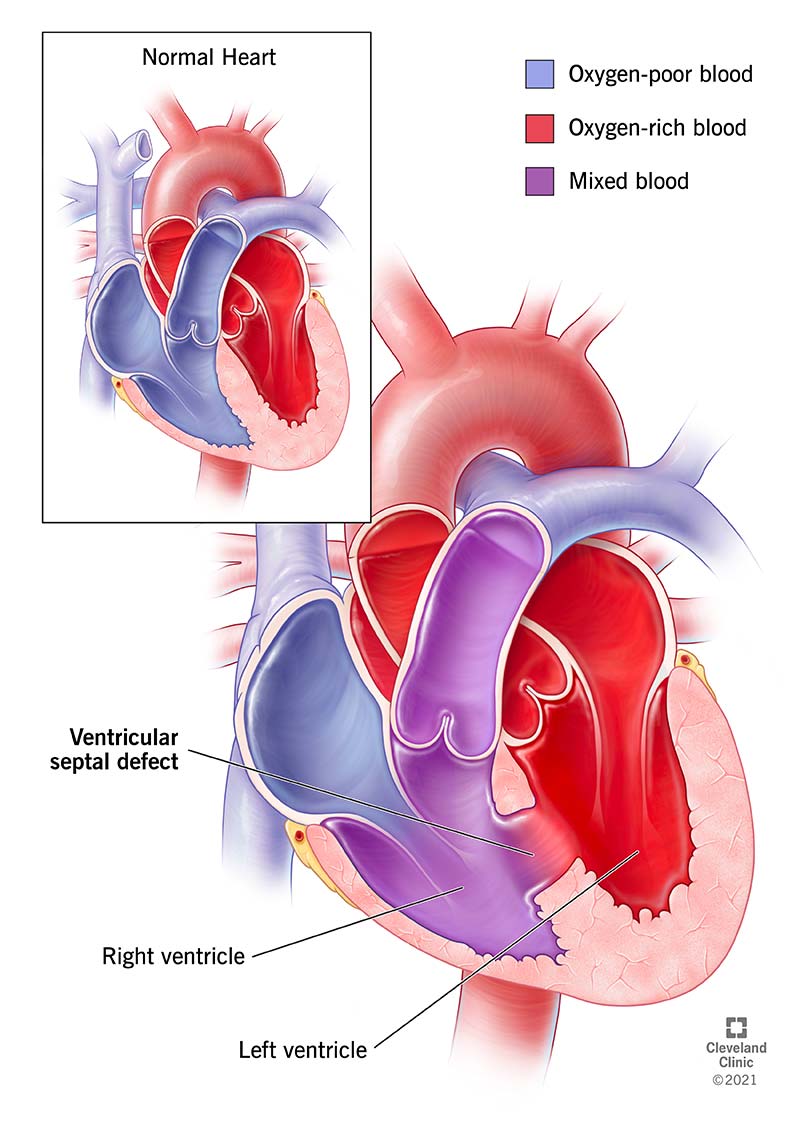
What is a ventricular septal defect?
A ventricular septal defect is a condition where yous're born with a pigsty in the wall betwixt the two lower chambers of your heart. Oft shortened to VSD, this condition is the most common congenital (meaning you have it when y'all're born) eye defect and often happens alongside other types of center issues or defects. A small VSD is ordinarily minor and has few or no symptoms. However, a larger hole may need to be repaired to avert permanent damage and complications.
What happens inside my centre if I have a ventricular septal defect?
Your eye has four chambers. To pump blood efficiently, the chambers much seal close. A VSD is a leak that disrupts that efficient pumping ability.
Nether normal circumstances, the right ventricle pumps oxygen-poor blood that just arrived from your body out of your eye and into your lungs so the blood can selection up oxygen. The blood then returns to the eye, and its last stop in the heart is the left ventricle, which pumps oxygen-rich claret out to your entire body.
A VSD is a potential trouble because information technology can act every bit a shunt (a connection) between the heart's ii lower chambers, the left ventricle and the right ventricle. Because the pressure in the left ventricle is higher than the pressure in the right ventricle, oxygen-rich blood mixes with oxygen-poor claret in the right ventricle then goes to the lungs. That leads to extra blood in the lungs which can cause serious bug.
Who does it touch on?
Almost all VSDs are present at nativity. A VSD diagnosis well-nigh probable happen during childhood, though adults can also receive this diagnosis. Nevertheless, this simply happens in 10% or less of cases. VSD is as well slightly more probable to happen in premature babies and babies with certain genetic conditions.
In very rare cases, a heart assault tin tear a hole between the ventricles and create a VSD. While this type of VSD — sometimes called ventricular septal rupture (VSR) — is technically a side effect, information technology is still a dangerous trouble that needs to be repaired.
How mutual is this status?
VSD happens in about one-third of 1% of all newborns. Withal, a VSD diagnosis in adults is much less likely because the defect closes on its own during childhood in xc% of cases.
VSDs that are a side event of a middle attack are extremely rare, especially because of modern centre assail treatment methods. Today, it happens in less than one% of all eye attacks.
What are the different types of VSD?
In that location are four master types of VSD, which differ in their location and the construction of the hole (or holes). The types of VSD are:
- Bleary: This is the most common blazon of VSD and makes up about 80% of cases. These VSDs happen in the upper section of the wall between the ventricles.
- Muscular: These account for nigh twenty% of VSDs in infants, and at that place is ofttimes more than ane hole that's role of the defect.
- Inlet: This is a hole that happens just beneath the tricuspid valve in the correct ventricle and the mitral valve in the left ventricle. That means when blood enters the ventricles, it must pass a VSD that connects the two chambers.
- Outlet (conoventricular): This kind of VSD creates a hole just before the pulmonary valve in the right ventricle and merely before the aortic valve in the left ventricle, connecting the ii chambers. That means blood has to become by the VSD on its style through both valves.
How does this condition affect my trunk?
VSD doesn't cause symptoms in most cases considering the pigsty isn't large enough to cause issues. However, in cases where the pigsty is large enough (or if there are multiple holes), it can cause bug with blood leaking between the ii chambers instead of circulating through the heart in the correct order.
That leaking makes your heart's pumping efforts less efficient, though if the leak is smaller, it may not be enough to cause whatever symptoms or bug. Yet, your eye needs to pump harder to compensate for the reduced claret catamenia when the leak is larger. When your heart works harder like that long-term, it can cause symptoms and problems in the heart and lungs that may go severe.
VSD size and furnishings
VSDs range in size from small-scale to large, with the size playing a function in what furnishings — if any — the VSD volition cause.
- Modest (iii mm in diameter or less): Most VSDs fall in this category and don't cause symptoms. About nine out of ten of this blazon will close on their own by the time a kid is vi years old. Surgery for these is rare.
- Moderate (3-5 mm in diameter): These VSDs don't usually crusade symptoms. If they aren't causing symptoms or problems elsewhere in the center and lungs, delaying surgery is usually advised because some likewise close on their own.
- Large (6-10 mm in diameter): These VSDs often require surgery (the timing of the surgery can vary slightly). Repair of a big VSD before historic period ii tin forestall damage to the centre and lungs. Without repair before age 2, the impairment becomes permanent and gets worse over fourth dimension.
When a moderate or big VSD is non treated in time, Eisenmenger syndrome tin can develop. This is a status where long-term damage to claret vessels in the lungs forces oxygen-poor claret from the correct ventricle through a large VSD and into the left ventricle. That ways some of the claret pumped to the body doesn't contain plenty oxygen. That causes an overall oxygen shortage throughout the body. This status is typically severe and can have major consequences on a person's life and the activities in which they can participate.
The left ventricle has greater pumping strength than the right, which means it tin force blood into the right ventricle. The right ventricle can't push the actress blood dorsum, so the extra blood instead gets pumped into the lungs. That puts too much pressure on and damages the lung's blood vessels. Over time, the damage in the lung'southward blood vessels starts to strength the leak in the middle to contrary direction, forcing oxygen-poor blood from the correct ventricle into the left.
Once the direction of the leak reverses, the damage is permanent and repairing the hole will crusade correct-sided centre failure. Surgical repair of a moderate or large VSD earlier historic period two is vital to prevent permanent damage and developing Eisenmenger syndrome.
Symptoms and Causes
What are the symptoms?
In infants, moderate to big VSD causes symptoms that await like eye failure. These include:
- Shortness of breath, including fast breathing or struggling to breathe.
- Sweating or fatigue during feeding.
- Failure to thrive (boring weight gain).
- Frequent respiratory infections.
VSD in older children and adults tin can cause the post-obit:
- Feeling tired or out of breath hands when exercising.
- Slightly higher risk of center inflammation acquired by infections.
- After Eisenmenger syndrome develops, very stake skin or a blue tinge to skin and lips (a condition chosen cyanosis) may happen.
What causes the status?
VSD that's present at birth doesn't currently take any known causes. Yet, it does sometimes happen along with other heart defects, center conditions or genetic disorders. Taking sure anti-seizure medications (sodium valproate and phenytoin) or drinking alcohol during pregnancy may too increase the hazard of your child developing a VSD. However, it volition take more research to confirm if these are definite causes.
The just known cause of VSD is when information technology happens as a rare side issue of a eye assault.
Diagnosis and Tests
How is it diagnosed?
A physician tin can diagnose a VSD — specially when they're moderate- or large-sized — based on a combination of symptoms, a physical exam and imaging tests. A minor VSD may get undetected when the hole is as well small to cause signs or symptoms.
A concrete test is ane of the most common means for a doctor to discover a VSD. That's because a VSD — when it's big enough —causes a sound chosen a heart murmur that your doctor tin can hear when listening to your heart with a stethoscope. It's fifty-fifty possible to estimate the size of the defect from the audio of a murmur.
What tests will exist done to diagnose this condition?
Other tests that help diagnose VSD include the following imaging tests:
- Echocardiogram: This test sends ultra-high-frequency sound waves through your trunk from a device held against the skin of your breast. Those audio waves create a moving picture of the inside and outside of the heart. Depending on the size of the VSD and its exact location, it'southward likely to be visible on an echocardiogram. This test is also painless and merely takes minutes to complete.
- Electrocardiogram (ECG or EKG): This test uses multiple sensors fastened to the skin of your chest to detect the electrical activity of your heart. That activity appears as a wave on a printout or digital brandish for a healthcare provider to review and translate. Over time, your heart structure can alter considering of a VSD. When the construction changes, the electrical pattern also changes. Even so, this test volition ofttimes exist normal if the VSD isn't big enough or if the center hasn't started to change shape.
- Breast or heart 10-ray: When a VSD is large enough, information technology will crusade the structure of your middle to change. That modify is visible on certain types of breast or heart 10-rays. In some cases, it besides involves injecting a substance into the claret that is easily visible on X-rays, which allows healthcare providers to see whatever unusual blood apportionment that indicates a VSD or other problem.
- Computed tomography (CT) scan: This examination uses a computer to process X-ray images into a three-dimensional flick of the inside of the middle. Like with a chest or heart Ten-ray, an injectable substance that'southward highly visible on a CT scan may help.
- Cardiac catheterization: This procedure uses a catheter device to wait at the heart from the inside. A specialist inserts the device into a major claret vessel, usually one almost your upper thigh, and and so passes it up to your heart. Once inside your heart, it can help pinpoint the size and location of any issues like a VSD. The most likely reason to apply this exam is when a healthcare provider suspects blood vessel damage in the lungs.
Management and Treatment
How is it treated, and is there a cure?
The majority of VSDs are too pocket-sized to crusade any kind of problem, and they volition likely shut on their own past age 6. In those cases, a healthcare provider is likely to recommend against surgery, advise monitoring for symptoms and encounter if the defect closes independently. When VSDs are moderate-sized or larger, your physician will likely recommend repairing the VSD by closing the hole.
The ii main ways to repair a VSD are:
- Surgery: The nigh reliable manner to shut a VSD is to patch it surgically. To do this, a cardiac (heart) surgeon volition operate and patch or shut the hole. Depending on the size and location of the hole, it may be equally simple as stitching the hole shut. In other cases, information technology might involve a patch fabricated of a synthetic cloth or a graft of your ain tissue.
- Transcatheter procedures: Like cardiac catheterization, these procedures use a transcatheter (catheter-based) approach to admission the heart via a major avenue. Once the catheter device reaches the defect, it can place a specialized device called an occluder and plug the hole. These devices are typically made of a mesh framework covered in a constructed material.
In either of the above cases, your heart tissue will grow over and around the patch or occlude device. Ultimately, the patch or device should get function of the eye wall between the ventricles.
In cases where an infant or child is underweight or isn't growing at the expected charge per unit, their healthcare provider may recommend special measures to help them get enough nutrition. This might include a special nutrition or fifty-fifty a feeding tube.
What medications/treatments are used?
Medication tin can treat symptoms of a VSD before surgery or if the VSD is probable to close on its ain over fourth dimension. Common medications for VSD are often the same as those that care for heart failure. They include:
- Diuretics: These medications increment the amount of fluid your kidneys remove from your trunk. This is helpful when fluid is building up effectually your heart, a common upshot of heart failure. These medications may brand you urinate (pee) more than frequently.
- Middle failure medications: These medications assist command the strength and timing of your heartbeats. An case is digoxin, a common medication in the treatment of eye failure that is also helpful for VSD.
What are the possible complications or side effects of the treatments?
In general, your healthcare provider is the best person to explicate the potential risks, complications and side effects that are possible with a VSD or related procedures and treatments. This is specially true for any recommended medications.
Common side effects or complications from surgery or transcatheter procedures for a VSD include:
- Haemorrhage.
- Infections, especially heart infections within the first six months later surgery.
- Disruption of nearby heart valves, causing them to leak.
- Heart rhythm problems (arrhythmias and heart blocks), which might lead to implantation of a pacemaker or indefinite handling with medication.
- Follow-up surgery to shut a recurring hole.
How soon after handling will I feel better, and how long does it take to recover from this treatment?
Recovery from repair of a VSD depends on the method used. Transcatheter procedures have shorter recovery times, with recovery times measured in days or weeks. Surgeries have longer recovery times, measured in weeks or months. Symptoms of a VSD usually decrease or disappear afterwards surgery or transcatheter repairs.
Prevention
How can I forbid this condition or reduce my risk?
Because at that place aren't any known causes for VSD, prevention isn't usually possible. However, you can subtract the risk by avoiding alcohol use and certain anti-seizure medications during pregnancy.
Outlook / Prognosis
What tin can I wait if I take this condition?
Almost adults with a VSD don't know near it because it isn't large enough to cause any problems. However, the larger the VSD, the more than likely it will impact how you live your life, especially if information technology isn't repaired.
How long does a VSD last?
Approximately 90% of VSDs volition close on their own by the time a person turns half-dozen years old. Most of the remaining 10% of VSDs will shut past age 20. However, a VSD is unlikely to close on its own after that.
An adult with a VSD will have it for the rest of their life unless they undergo a process to repair it.
What's the outlook for this condition?
About people with a VSD have the aforementioned life expectancy as someone who doesn't accept one. This is peculiarly truthful if the defect closes on its own.
In cases of a moderate or large VSD, repair of the hole is usually enough to preclude Eisenmenger syndrome and related problems. In rare cases, a follow-up surgery becomes necessary to close new leaks around the repair. Unfortunately, most people with a moderate or large VSD — even 1 that's repaired —are more likely to take a lower life expectancy, especially if the VSD was not repaired early.
For people who take a VSD that isn't repaired, about 87% of them will exist alive 25 years after their diagnosis. The size of the VSD has a major consequence on the odds of survival, still.
- Small: Modest VSDs are unlikely to have a major touch on your life. Overall, 96% of people with an unrepaired small defect live more than 25 years after diagnosis.
- Moderate: Survival rates for people with unrepaired moderate VSDs are a little bit lower, with most 86% of them surviving at least 25 years after diagnosis.
- Large: Survival rates for people with a large unrepaired VSD are much lower. Only about 61% of these individuals are still live 25 years subsequently their diagnosis.
People who develop Eisenmenger syndrome from a moderate or big VSD tend to have the worst survival outlook. Only nigh 42% of these individuals will be alive at least 25 years afterward their diagnosis with a VSD. However, advancements in modern medicine are improving the outlook for individuals with this condition and some live to exist in their 70s.
Living With
How can I take care of myself and manage my symptoms?
Overall, you should inquire your healthcare provider for guidance on managing your symptoms and taking intendance of yourself. Their advice will be all-time suited to you lot considering they can see the overall picture of your health and medical situation and tailor the guidance they give you lot accordingly.
If y'all take symptoms because of a VSD, your healthcare provider will likely propose you to balance and avoid too much concrete activeness or any activity that puts too much strain on your heart. This is peculiarly truthful if you lot have Eisenmenger syndrome related to an untreated VSD. You should also exist sure to accept medications exactly as instructed and just modify or finish taking medications if you take talked to your healthcare provider and they have confirmed information technology's safe to practise so.
When should I see my healthcare provider?
When you don't know about a VSD
If y'all accept an infant that doesn't have a VSD that y'all know of, you should talk to their healthcare provider if you discover whatever of the following symptoms:
- Slower than expected growth or weight gain.
- Sweating or getting tired while feeding.
- If they are very fussy or show signs of trouble animate.
- If they have frequent respiratory infections.
If you lot are an developed and aren't enlightened that you lot accept a VSD, yous should talk to your healthcare provider if you lot notice that you get tired or brusque of breath hands when you're physically active, or if yous are often pale or notice a blueish tint to your fingertips or lips.
When you know about a VSD
If your child has a VSD, their healthcare provider tin can advise you on potential signs and symptoms of VSD-related problems. In general, wait for the same symptoms of VSD that are described to a higher place. You should also talk to their healthcare provider if you observe any sudden or unusual changes in their existing symptoms.
If you accept a VSD, you should also talk to your healthcare provider if you lot have any sudden changes in your symptoms. You should also talk to a healthcare provider virtually your condition earlier you take whatsoever surgery or dental work to brand sure they know nearly your condition.
When should I go to the ER?
Your healthcare provider or the provider caring for your child tin explicate when you should become emergency medical care for symptoms that are or might be related to a VSD. In general, you should become to the emergency room if you or your child have trouble breathing or any signs of cyanosis (pale or bluish skin, lips or fingernails).
A annotation from Cleveland Clinic
If you or your kid have a ventricular septal defect, information technology's normal to experience concerned, anxious or even scared. If you're dealing with these kinds of feelings, it's a good idea to talk to your healthcare provider or the provider caring for your kid. They can help you better understand the condition and what to expect. More importantly, they tin aid you detect ways to treat this status, prevent complications and minimize how it affects the life of you or your kid.
Source: https://my.clevelandclinic.org/health/diseases/17615-ventricular-septal-defects-vsd
0 Response to "A Baby Was Born With a Ventricular Septal Defect (Vsd). Course Hero"
Post a Comment